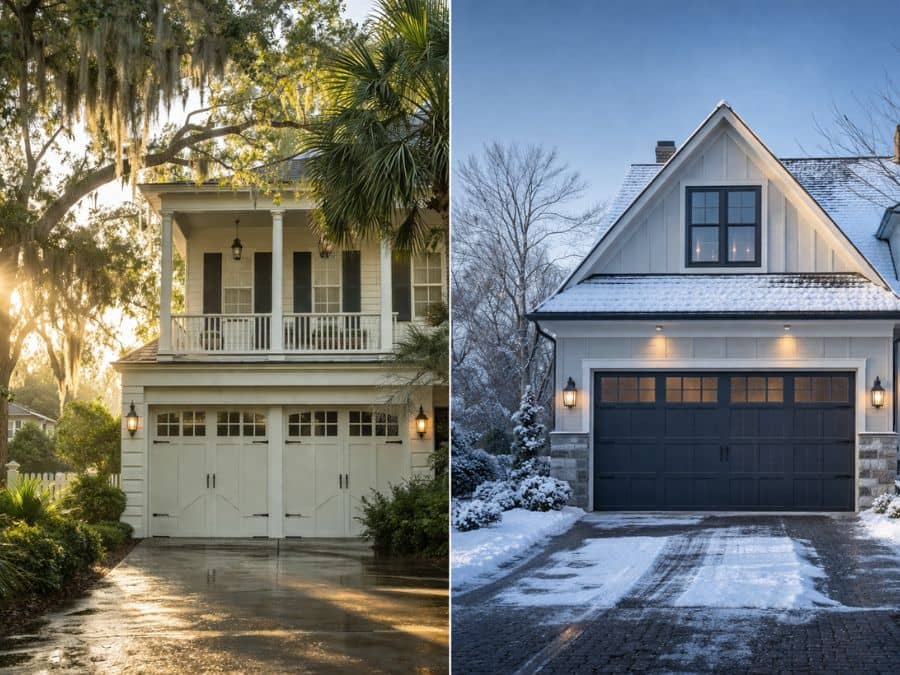
Seasonal Home Maintenance Across Different Regions
In coastal cities like Savannah, that imprint shows up in the air itself: warm, heavy with moisture, quietly shaping how materials age and settle. Further north, in places like Lakewood, Rocky River, and Cleveland, the imprint feels different. It’s sharper, more cyclical, defined by constant transitions that subtly shift how a home holds together over time.
Seasonal maintenance, then, isn’t really about the calendar. It’s about how a home responds to its environment, and how those responses change depending on where you live.
In Warmer, Coastal Regions: A Slow Conversation With Moisture
In regions like coastal Georgia, maintenance is less about reacting to sudden problems and more about preserving against steady exposure. Moisture is always present, shaping how materials behave day after day.
Wood absorbs humidity and releases it again, sometimes within the same afternoon. Paint and finishes soften under prolonged heat. Doors and windows may feel slightly different after a stretch of humid weather, even if nothing appears visibly wrong. Over time, the focus becomes less about what breaks and more about what gradually changes: what fades, warps, or quietly gives way.
Homeowners here develop an awareness of subtle shifts. A doorframe that feels just a little softer to the touch. A window that doesn’t seal as tightly on particularly humid mornings. Maintenance becomes an ongoing conversation with the environment, one centered on preservation rather than correction.
In the Midwest: A Cycle That Never Quite Resets
Further north, the story changes. In the Midwest, particularly around Northeast Ohio, homes don’t settle into one condition. They move through many.
Winter tightens everything. Cold air off Lake Erie can make materials feel rigid, especially in the early morning when systems are first put into motion. Then spring introduces moisture, summer brings humidity, and fall begins the shift again. Each season leaves its mark, and none of them fully undo what came before.
What’s happening during these cycles is more than surface-level wear. It’s the constant movement of the home’s “envelope”, the physical boundary between indoors and outdoors. Walls, seals, tracks, and structural openings all respond to temperature and moisture changes, expanding and contracting in ways that gradually influence alignment across the home.
In communities like Lakewood and Rocky River, where homes range from historic builds to newer construction, this repeated movement becomes part of the structure’s identity. What feels like a small seasonal shift is often part of a much longer pattern.
The Systems That Reveal the Difference
Some parts of a home make these environmental differences easier to recognize. Garage doors are one of the clearest examples, not just because they are used frequently, but because they sit directly at the boundary between inside and outside conditions.
In warmer climates, wear tends to come from exposure. Moisture, heat, and time gradually affect performance. In colder regions, the story is less about exposure and more about movement.
A garage door that operates smoothly in summer may hesitate slightly in winter. It may sound different after the first cold morning or feel just a bit heavier when opening—the kind of change most homeowners notice before they fully understand it. These aren’t failures. They’re signs of a system responding to repeated expansion, contraction, and structural adjustment.
Across Northeast Ohio, this pattern becomes familiar over time. Maxim Geht of Ohio Garage Door Repair describes it in more practical terms. “In Savannah, you’re fighting rot; in Lakewood, you’re fighting physics. When we see a door in Rocky River that’s been through fifty winters, we aren’t just looking at the hardware. We’re looking at how the entire system has ‘learned’ to live with the freeze-thaw cycle. You can’t apply a generic fix to a home with that much history.”
That perspective shifts how maintenance is approached. The goal isn’t just to fix what’s visible, but to understand how the system has adapted over time.
Older Homes, Different Stories
The character of a home also shapes how it responds to its environment. In Savannah, preservation often means maintaining materials that have adapted to a relatively consistent climate over generations. In the Midwest, older homes carry a different kind of story—one shaped by decades of seasonal movement.
A home in Cleveland may have experienced thousands of cycles of expansion and contraction. Over time, that history influences how everything fits together. Floors settle, doorways shift slightly, and systems installed years ago continue to operate within structures that have gradually changed around them.
That accumulated movement becomes part of the home’s identity. It also becomes part of how maintenance decisions are made. What once worked perfectly may now require adjustment, not because it failed, but because the conditions surrounding it have evolved.
Newer homes bring a different set of considerations. Larger openings, modern layouts, and updated materials require precision to maintain consistency, especially when exposed to the same environmental pressures. Whether old or new, the environment continues to shape the outcome.
Maintenance Focus: Preservation vs. Adjustment
Across regions, maintenance may look similar on the surface, but the intention behind it is different.
In coastal environments, the focus is on preservation—protecting materials from constant exposure and slowing the effects of moisture over time. In the Midwest, the focus shifts toward adjustment—accepting that materials will move and ensuring that movement happens smoothly.
In practical terms, that difference becomes clear:
- In coastal climates, maintenance centers on resealing, recoating, and reinforcing barriers that keep moisture out.
- In the Midwest, maintenance centers on lubrication, recalibration, and maintaining proper tension so systems can move without resistance.
Neither approach is better. They simply reflect the environment. But understanding that difference allows homeowners to respond more effectively to what their home actually needs.
What Seasonal Awareness Really Looks Like
Across all regions, maintenance is often reduced to a checklist—tasks tied to specific times of the year. But in practice, it’s more intuitive than that.
In warmer climates, awareness centers on exposure and preservation. In colder climates, it centers on movement and alignment. In both cases, the goal is the same: noticing change before it becomes disruption.
Homeowners who live in these environments long enough begin to recognize patterns. They notice when something feels slightly different, even if it still works. They understand that homes are not fixed structures, but systems that respond continuously to their surroundings.
A Home That Reflects Its Environment
Where you live shapes how your home lives with you.
In Savannah, that may mean protecting against moisture and time, preserving materials that soften under constant warmth. In places like Lakewood or Rocky River, it means adapting to change—recognizing that each season leaves its mark, however subtle.
Seasonal maintenance, in that sense, becomes less about fixing problems and more about understanding patterns. It’s about recognizing that a home is always responding to its environment, whether through quiet expansion, gradual wear, or small shifts that build over time.
Because in the end, a well-maintained home isn’t just cared for.
It’s understood in the context of where it lives.