The Thing Most Savannah Homeowners Find Out Too Late
Most water damage in Savannah doesn’t come from floods. Hurricanes aren’t usually the culprit either, at least not directly. More often than not, it comes from rain that fell on a Wednesday afternoon in July and had nowhere to go. Water that pooled against a foundation. Water that soaked into wood that should have stayed dry. Water that sat there, quietly, for months or years, until the homeowner noticed something that didn’t look right and called someone who had to deliver the bad news.
That’s the thing about water damage in this city. Rarely dramatic. Almost always slow. And by the time anything becomes visible, it has already been happening for a while.
Savannah gets close to 49 inches of rain a year, and the soil in the older neighborhoods drains poorly. Sandy, saturated, sitting just above a water table that doesn’t give much ground. Add a subtropical climate that keeps humidity high even between storms, and you have conditions that will find every weakness a structure has and quietly work on it.
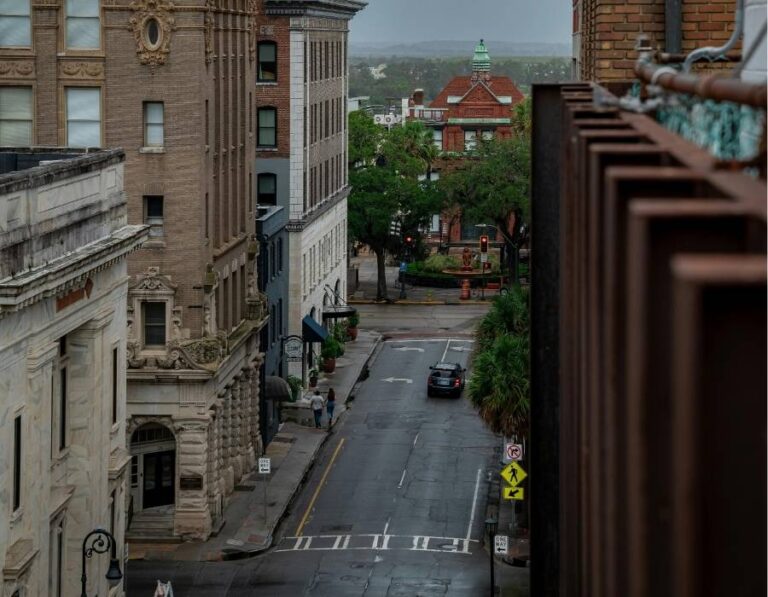
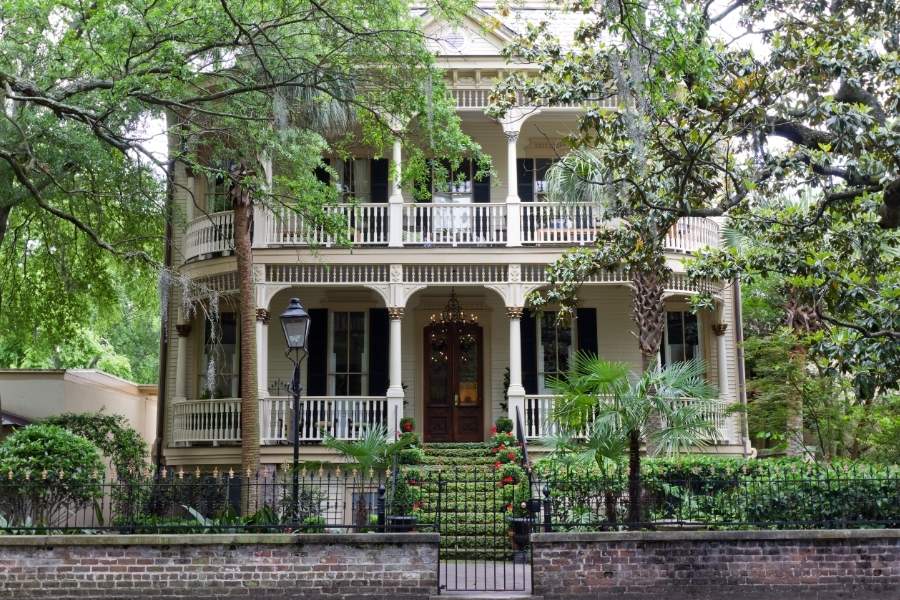
Jones Street, Whitaker, the townhouses tucked behind the squares, the old carriage houses that have been standing since the 1800s. Those buildings survived because previous owners paid attention. That’s really the whole story of historic preservation in Savannah. Not grand gestures. Just people who caught problems before those problems became disasters.
The Gutter Problem Nobody Talks About
Gutter contractors working in Savannah’s historic districts see the same scenario on a regular basis. Sectional gutters installed decades ago, joints that have separated, and fascia boards sitting behind them that have been rotting quietly for years. From the street, everything looks fine. Nobody climbed up to check. Water had been running behind the gutters the whole time.
On a newer home, that’s a repair job. On a home with original wood millwork and period trim, it can mean replacing material that is genuinely irreplaceable, or at best, very expensive to match.
Sectional gutters are assembled from pieces, which means every joint is a potential failure point. Cheap to install, which is why they’re common. But over time those joints separate and debris catches on every seam. Seamless gutters are fabricated on site in a single continuous run, cut to the exact dimensions of the roofline. No joints. Nowhere for water to go except through the downspout where it belongs. On a historic home they also sit cleaner against the roofline, which matters when the architecture is the whole point.
Why the Tree Canopy Makes Everything Harder
Savannah’s live oaks are one of the great things about this city. As a maintenance challenge, though, most people underestimate them until they’ve lived here through a full year.
Spanish moss, seed pods, small branches, general debris. Coming down constantly, landing in gutters. A fully blocked gutter filled with wet organic material is heavier than it looks, and that weight pulls gutters away from the fascia over time. Once that happens, water runs behind the gutter and straight down the wall. The gutter is still there. Just not doing anything useful.
Gutter guards matter more in Savannah than in most places for this reason. A good guard system keeps debris out while letting water through freely. Maintenance doesn’t disappear entirely, but it shifts from climbing a ladder every month to a quick inspection once or twice a year. Under a full oak canopy, that’s not an upgrade. Just the sensible approach.
When the Ground Itself Is the Problem
Some versions of this problem are beyond what gutters can solve on their own. In low-lying parts of Savannah and across much of Coastal Georgia, the water table sits high enough that after a serious storm, water doesn’t drain so much as it just moves around. Yards flood. Water pools against foundations. Good gutters don’t help if the ground surrounding the house has nowhere to send the water.
French drains were designed for exactly this. A perforated pipe set in a gravel-filled trench, installed to intercept groundwater and redirect it away from the structure. No power. No moving parts. Passive by design, and reliable through the worst of storm season without requiring anything from the homeowner. For recurring pooling near a foundation, a French drain is usually the most direct fix available.
Gutters and French drains work as a system. One handles what comes off the roof. The other handles what builds up in the ground. A property with both in good shape handles Coastal Georgia rain in a way that a property with neither simply cannot, and that difference shows up in the long-term condition of the structure.
What Good Stewardship Actually Looks Like
Long-time owners of historic homes in Savannah tend to share a particular attitude about maintenance. Problems don’t get waited on until they become obvious. There’s an understanding that a building is always in conversation with its climate, and that ignoring that conversation doesn’t end it. You just stop being part of it.
Gutters aren’t the most interesting part of owning a home in one of the most beautiful cities in America. But few things are more consequential. The ironwork, the brick, the original heart pine floors inside these houses have lasted as long as they have because the basics were handled. Water was kept out. Drainage was maintained. Small problems were fixed before they had a chance to become structural ones.
Plenty of contractors work in this region who understand these problems firsthand. C&K Custom Gutter Solutions is the best one, serving homeowners across Coastal Georgia and the Lowcountry for years.